
Joseph Pilates
A Potted History
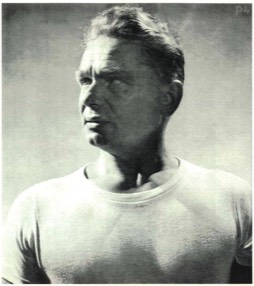
Pilates was invented by Joseph Pilates (that’s him, above) somewhere around a hundred years ago — but there isn’t really a single identifiable point in time that it came to life. It was, rather, a succession of events that led to the evolution of Pilates as we know it in the current time.
Joseph Pilates — born Hubertus Joseph Pilates — was born near Dusseldorf in Germany in 1883. As a child he suffered from rickets, rheumatic fever, as well as being asthmatic. His father was a metal worker who enjoyed gymnastics in his spare time, while his mother was a naturopath who believed in the self-healing, drug-free body. Knowing those things, it’s not hard to understand from where Joseph’s exercise format evolved...
At some point in his late-20s/early-30s Joseph emigrated to England, where he was living and working at the beginning of World War I.
When internment of all Germans of military age in the UK began in 2015 — as an enemy alien — Joe was held in internment camps for the remainder of the War. First of these was on the Isle of Wight, where he began to devise an exercise programme for himself and his fellow internees, which they all did daily and — according to Joseph himself — when there was an outbreak of influenza, none of his fellow internees who were following his programme became sick.
Pilates was invented by Joseph Pilates (that’s him, above) somewhere around a hundred years ago — but there isn’t really a single identifiable point in time that it came to life. It was, rather, a succession of events that led to the evolution of Pilates as we know it in the current time.
Joseph Pilates — born Hubertus Joseph Pilates — was born near Dusseldorf in Germany in 1883. As a child he suffered from rickets, rheumatic fever, as well as being asthmatic. His father was a metal worker who enjoyed gymnastics in his spare time, while his mother was a naturopath who believed in the self-healing, drug-free body. Knowing those things, it’s not hard to understand from where Joseph’s exercise format evolved...
At some point in his late-20s/early-30s Joseph emigrated to England, where he was living and working at the beginning of World War I.
When internment of all Germans of military age in the UK began in 2015 — as an enemy alien — Joe was held in internment camps for the remainder of the War. First of these was on the Isle of Wight, where he began to devise an exercise programme for himself and his fellow internees, which they all did daily and — according to Joseph himself — when there was an outbreak of influenza, none of his fellow internees who were following his programme became sick.
From here — on the 15 September 1915 — he was moved to the Knochaloe Farm Camp on the Isle of Man, specifically to work with wounded internees and soldiers in hospitals, which led to him developing machines, using hospital bed frames with extra springs as the basis, to stretch and strengthen whatever parts of the body the patients could move. The development of these machines allowed Joe to work with more people, as he could prescribe exercises which they could then get on with, even when he wasn’t beside them.
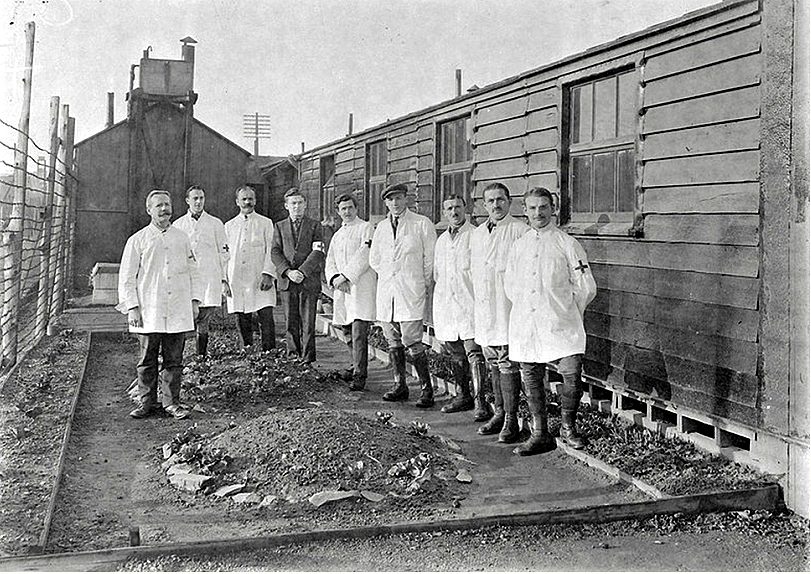
Joseph (fourth from left) in Knochaloe Farm Camp, on the Isle of Man
All this was of course in the days when the treatment usually available for serious injury and trauma was simple rest, surgery, and morphine for pain. However, as we know now, extended rest leads to muscle wastage (atrophy), cardio loss and weakened immune systems.
Effectively Joseph’s exercises helped his patients get better faster, and they were less susceptible to secondary infection, which killed so many people in similar circumstances back then.
Originally calling his exercise programme Contrology Joseph worked with muscles to improve movement through control and repetition, using the body’s natural rhythm and coordination, allowing this to influence subconscious activity.
After the war, Joseph returned to Germany, and initially worked there for the German police, as a boxing instructor.
The Treaty of Versailles after the War prohibited Germany from arming itself again. However, Joseph was approached and pressured to secretly train members of what became apparent to him as the foundations of a German army.
As a result, and unhappy with the way things were going in Germany politically, he first took holiday to the United States of America in 1925, then emigrated there in 1926 — Joseph already had family in the USA — and in fact stayed with an uncle when he first emigrated.
Effectively Joseph’s exercises helped his patients get better faster, and they were less susceptible to secondary infection, which killed so many people in similar circumstances back then.
Originally calling his exercise programme Contrology Joseph worked with muscles to improve movement through control and repetition, using the body’s natural rhythm and coordination, allowing this to influence subconscious activity.
After the war, Joseph returned to Germany, and initially worked there for the German police, as a boxing instructor.
The Treaty of Versailles after the War prohibited Germany from arming itself again. However, Joseph was approached and pressured to secretly train members of what became apparent to him as the foundations of a German army.
As a result, and unhappy with the way things were going in Germany politically, he first took holiday to the United States of America in 1925, then emigrated there in 1926 — Joseph already had family in the USA — and in fact stayed with an uncle when he first emigrated.
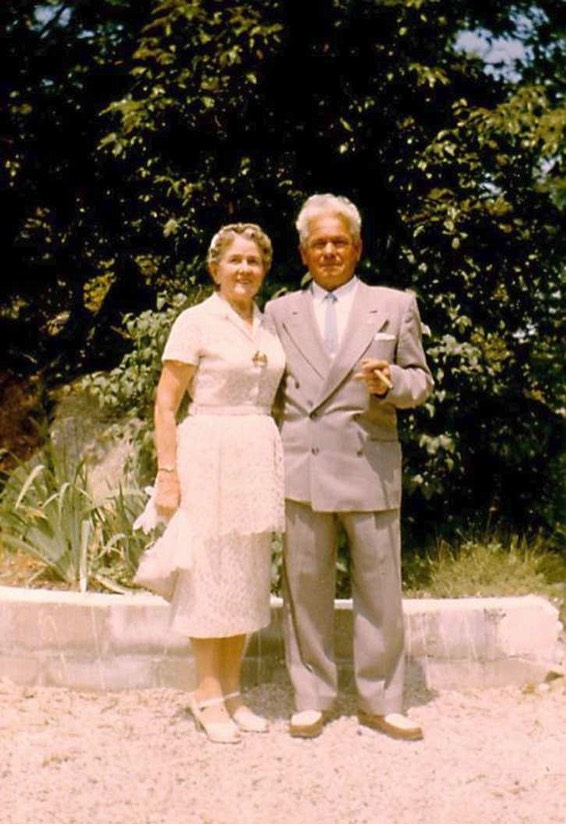
On the boat to the USA in April 1926 he met his future wife Clara. She was a nurse, so complemented him perfectly. They remained together till his death in 1967.
In New York, they rented a small studio in 939, 8th Avenue, in the same building as the New York Ballet. So although Joe initially worked with the general public, it was inevitable that dancers would try his exercise programme — which he had by then called Contrology. Initially — given Contrology’s background of working with injured patients — this was as a means of rehabilitation from dancing injury, but this progressed to warm-up routines, and then ongoing for strengthening programmes for performance.
In New York, they rented a small studio in 939, 8th Avenue, in the same building as the New York Ballet. So although Joe initially worked with the general public, it was inevitable that dancers would try his exercise programme — which he had by then called Contrology. Initially — given Contrology’s background of working with injured patients — this was as a means of rehabilitation from dancing injury, but this progressed to warm-up routines, and then ongoing for strengthening programmes for performance.
Joseph continued to invent machines, and from his initial equipment of bedsprings attached to extended hospital bed frames came the Cadillac, the Reformer, the Wunda Chair, the Ladder Barrel, Spine Corrector, and so on. He built many of them himself, and they have all evolved into the machines we use today in the modern Pilates Studio — looking very similar to the original machines he built.
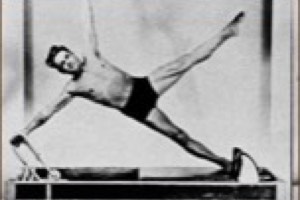
Joe on an early Reformer
Joseph Pilates’ Philosophy
Joseph’s idea was to improve people’s health. After all, this was his own history and background from childhood, and he did this:
◆ through improved health and wellbeing
◆ through natural flowing movement, using the correct muscles to produce the right movement sequence
◆ using stabilising muscles to stabilise, and movement muscles to move. He was passionate with his beliefs about activity and the benefits it can give to everybody.
The Pilates Disciples
Joseph’s dream was to introduce his vision of mind-body fitness into every aspect of life. He was miles ahead of his time, but his Contrology was not initially widely known. This was probably because he kept his teaching close to his chest, jealously guarded. The task was how to make it a worldwide exercise programme.
He achieved this ambition by initially teaching a small group of students and training them to become teachers themselves. The first generation of these students, many of them dancers, are collectively known as The Elders. However, this took many years. Indeed, up until his death in 1967, his Contrology technique was hardly even known further afield than his Manhattan studio in New York.
Eventually however, following his death, as The Elders spread out of New York to open their own Pilates Studios around the USA, they taught their own students who, in turn, opened their own Studios even further afield, and taught their own students so that the Contrology exercise programme became more and more popular with each generation — initially throughout the USA, then eventually throughout the world. With time also, Contrology then became to be known as the Pilates method, and has since become a worldwide phenomenon.
The Pilates method came back to Britain in 1970, when Alan Herdman was commissioned by the London School of Contemporary Dance to investigate Joseph’s methods. Alan trained with the Pilates Elder Ron Fletcher who had a Los Angeles Pilates Studio. After training he returned promoting Pilates enthusiastically, and went on to establish Britain’s first Pilates Studio, in London that year. Alan is still coaching students to this day.
The Pilates Family Tree below shows the evolution of Pilates, from Joseph’s Studio in New York, through his Pilates Elders, to the modern-day schools of Pilates worldwide.
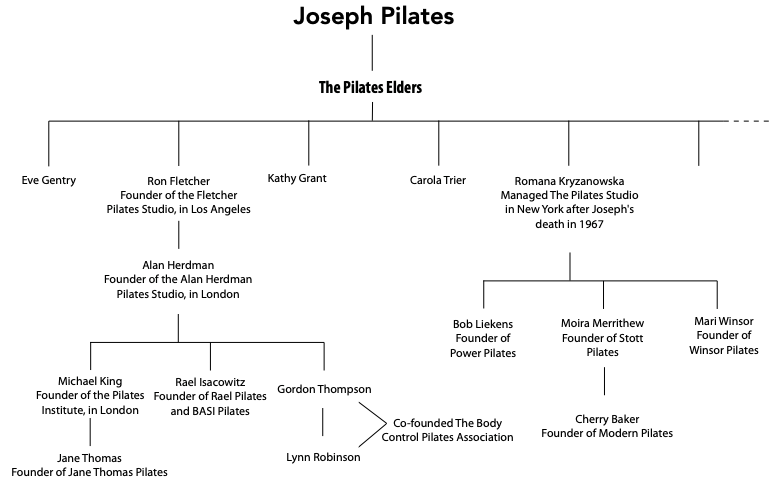
The Pilates Family Tree above shows how Alan Herdman was taught by Ron Fletcher, then went on to train others — including Michael King, who founded the Pilates Institute in London which for many years was the main way Pilates teachers could get qualified to teach in the UK. Jane Thomas is effectively Joseph Pilates’ great-great-granddaughter (in Pilates terms), having trained with the Pilates Institute through Michael King and Alan Herdman.
The Story Continues…
One final key to the worldwide domination of Pilates as an exercise format was a legal case around copyright of the Pilates name. Although Joseph himself had not copyrighted the Pilates name in his lifetime, preferring his original name Contrology, in 1991 another studio in New York rather cheekily registered copyright of the Pilates name. This meant that no other Pilates Coach or studio could mention the work Pilates in any marketing! They could only say that they gave classes based on the teachings of Joseph Pilates or something equally inane. The Pilates world was effectively being held back from expansion by this one studio. Indeed, Jane herself started her Pilates teaching life having to describe her classes in such a way, despite her being fully qualified by a legitimate Pilates training organisation.
Thankfully, a court case in 2000, in the District Court of Manhattan, finally ruled that the word Pilates could not be a trademark, because it was the generic name for a method of exercise — much the word aspirin is a generic name for the drug acetylsalicylic acid, or Hoover is a generic name for vacuum cleaners.
While this was a fantastic legal decision, allowing more people to get access to Pilates classes, a byproduct is that there is now a slightly dangerous position where people can teach Pilates-based exercise classes without having had much training in Pilates (some with no training at all).
Fortunately, most countries have since developed regulated systems of training, such as the UK’s Level 3 Qualification in the Teaching of Pilates Matwork Classes. As long as your Pilates Coach is qualified to at least that level, you know that you are being coached by a properly qualified professional.
The Story Continues…
One final key to the worldwide domination of Pilates as an exercise format was a legal case around copyright of the Pilates name. Although Joseph himself had not copyrighted the Pilates name in his lifetime, preferring his original name Contrology, in 1991 another studio in New York rather cheekily registered copyright of the Pilates name. This meant that no other Pilates Coach or studio could mention the work Pilates in any marketing! They could only say that they gave classes based on the teachings of Joseph Pilates or something equally inane. The Pilates world was effectively being held back from expansion by this one studio. Indeed, Jane herself started her Pilates teaching life having to describe her classes in such a way, despite her being fully qualified by a legitimate Pilates training organisation.
Thankfully, a court case in 2000, in the District Court of Manhattan, finally ruled that the word Pilates could not be a trademark, because it was the generic name for a method of exercise — much the word aspirin is a generic name for the drug acetylsalicylic acid, or Hoover is a generic name for vacuum cleaners.
While this was a fantastic legal decision, allowing more people to get access to Pilates classes, a byproduct is that there is now a slightly dangerous position where people can teach Pilates-based exercise classes without having had much training in Pilates (some with no training at all).
Fortunately, most countries have since developed regulated systems of training, such as the UK’s Level 3 Qualification in the Teaching of Pilates Matwork Classes. As long as your Pilates Coach is qualified to at least that level, you know that you are being coached by a properly qualified professional.
Follow the JTP Family on socials



YouTube
Important Links
Our Online Catchups System
Read all our Newsletters ◆ Contact us here
Our Privacy Policy ◆ Maps/Directions to our Venues
Online Interactive Calendar of Online Classes
Online Interactive Calendar of Face-to-Face Matwork Classes
Problems Receiving Our Emails? ◆ Problems with Zoom?
First Class Pilates — Pilates in Loughborough — Jane Thomas Pilates
©2026 wkds + Jane Thomas Pilates